
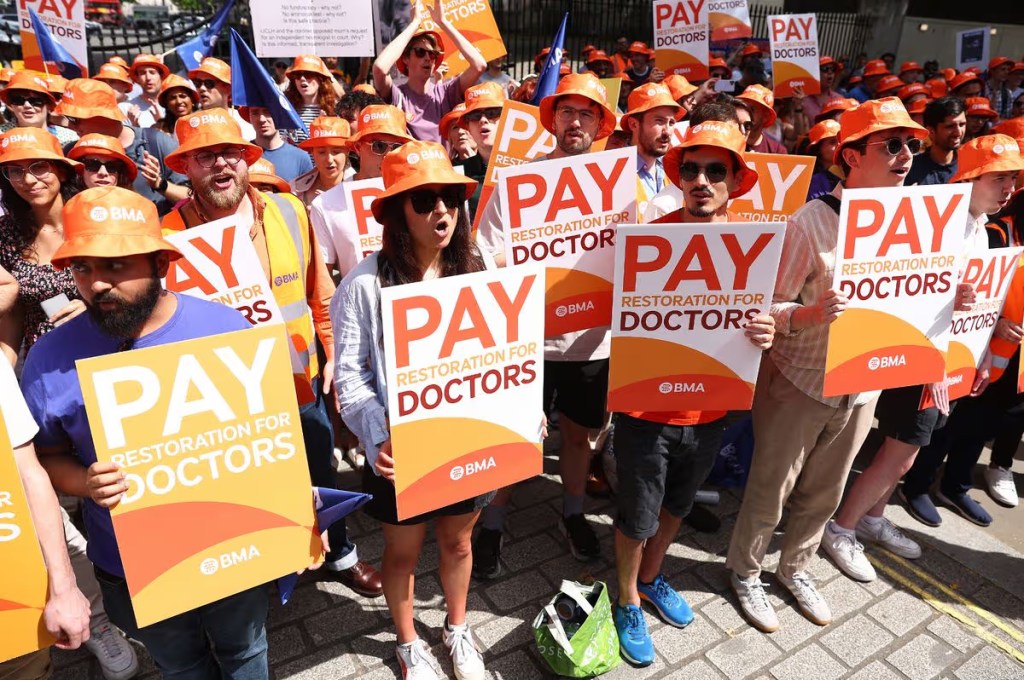
The latest doctors’ strike is not simply another disruption to NHS services. It is the 15th walkout since 2023 and marks a deeper turning point in how the public views the system. With waiting lists at 7.2 million cases – likely closer to 9 million in reality – and more than 1.5 million appointments already cancelled, the NHS is no longer just under pressure. It is increasingly seen as unreliable, unpredictable and, for many patients, no longer fit for purpose.
Doctors have now embarked on their 15th round of industrial action since March 2023, taking total strike days beyond 60. This latest walkout, lasting six days, comes despite the Government’s insistence that resident doctors have been “by a country mile the best winners” in terms of public sector pay increases. Over the past four years, doctors have received pay increases that would leave them approximately 35% better off under the deal recently rejected by the British Medical Association.
Yet the BMA continues to demand further increases, arguing that real-terms pay has fallen over the past 18 years. Its current position is that doctors require an additional 26% increase to restore earnings. Even on more conservative measures of inflation, such as CPI, the decline is closer to 4.7%, rather than the 21% figure often cited.
This dispute is taking place against a backdrop of extraordinary pressure on the NHS. Waiting lists remain at 7.2 million cases – almost certainly closer to 9 million in reality – with more than 62% of patients waiting longer than 18 weeks for treatment. Orthopaedics continues to dominate this backlog, with hundreds of thousands of patients waiting for procedures that directly affect mobility, independence and ability to work.
The strikes are not occurring in isolation. They are compounding an already overloaded system. Fourteen previous walkouts have already led to more than 1.5 million appointments and procedures being cancelled or rescheduled. Each of these cancellations feeds back into the system, extending waiting times further and delaying treatment for patients who were already waiting too long.
The financial cost is equally stark. Industrial action has cost the NHS at least £3 billion to date – enough, by some estimates, to fund around 1.5 million operations. Each day of strike action is estimated to cost approximately £50 million. This is not simply lost productivity. It is a direct transfer of resources away from patient care.
At the same time, the structure of NHS staffing during strikes reveals a deeper inefficiency. Consultants are brought in to maintain essential services, often at significantly enhanced rates. Reports indicate that consultants can earn up to £6,000 for covering strike shifts, even if they are not ultimately called into work. Hourly rates for additional cover can range from £150 to £300. This creates a paradox: the system is forced to pay more to maintain a reduced level of service.
What is often overlooked in the public debate is the broader compensation structure of NHS doctors. In addition to salaries starting at £38,831 and rising during training, doctors benefit from one of the most generous pension schemes in the UK. These are defined benefit, index-linked pensions, guaranteed by the state and often worth close to 75% of final salary in retirement.
Doctors contribute between 5.2% and 12.5% of their salary to these schemes, while the state contributes 23.7% – almost eight times the typical employer contribution in the private sector. The NHS is now paying out nearly £1 billion per month in pensions, with almost 2,000 retirees receiving more than £100,000 annually. Taxpayer contributions to NHS pensions reached £17.2 billion in 2024–25, up from £13.7 billion the previous year.
This context matters because it complicates the narrative of a workforce that is simply underpaid. The issue is not straightforward. It is structural.
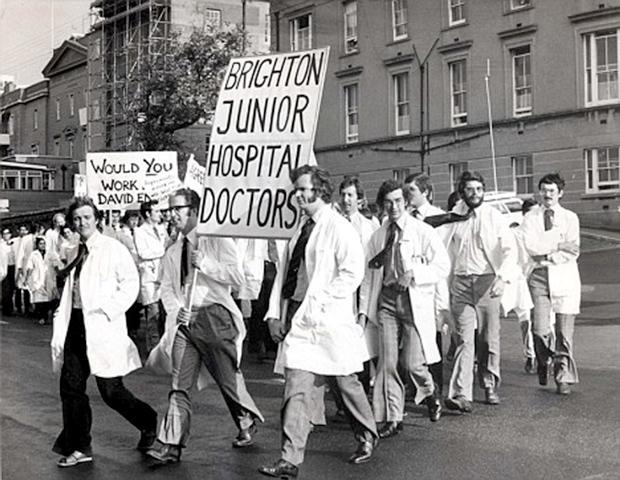
Historically, this tension is not new. When the NHS was founded in 1948, doctors resisted joining it. The British Medical Association opposed its creation, and only agreed after significant concessions preserved private practice and professional autonomy. The NHS was never a fully integrated workforce model. It was a negotiated settlement – one that still defines the balance of power today.
That balance is now being tested. Doctors, particularly resident doctors who make up around half of the workforce, occupy a position of considerable leverage. When they withdraw labour, the effect is immediate and system-wide. In practice, this allows a single professional group to exert disproportionate influence over a national service on which millions depend.
The consequences are now visible in patient behaviour. Data shows that 16% of people used private healthcare in 2025, up from 9% in 2023, with NHS delays cited as the primary reason. Private hospital admissions have surged, and an estimated 520,000 UK patients travelled abroad for treatment last year. These are not marginal changes. They represent a structural shift.
The strikes accelerate this shift by introducing a new layer of uncertainty. For patients already facing long waits, the risk of cancellation further undermines confidence. Healthcare depends on predictability. Once that predictability is lost, trust follows.
The result is a system that is increasingly dividing along economic lines. Those who can afford to bypass the NHS are doing so. Those who cannot are left to wait. The NHS, founded to eliminate inequality in access to care, is now contributing to a new form of it.
This is the real consequence of the current dispute. It is not just about pay. It is about control, structure and trust. And once trust begins to erode at scale, it does not easily return.
That is the point the NHS has now reached.
 My Medical Gateway Blog
Leave a comment