
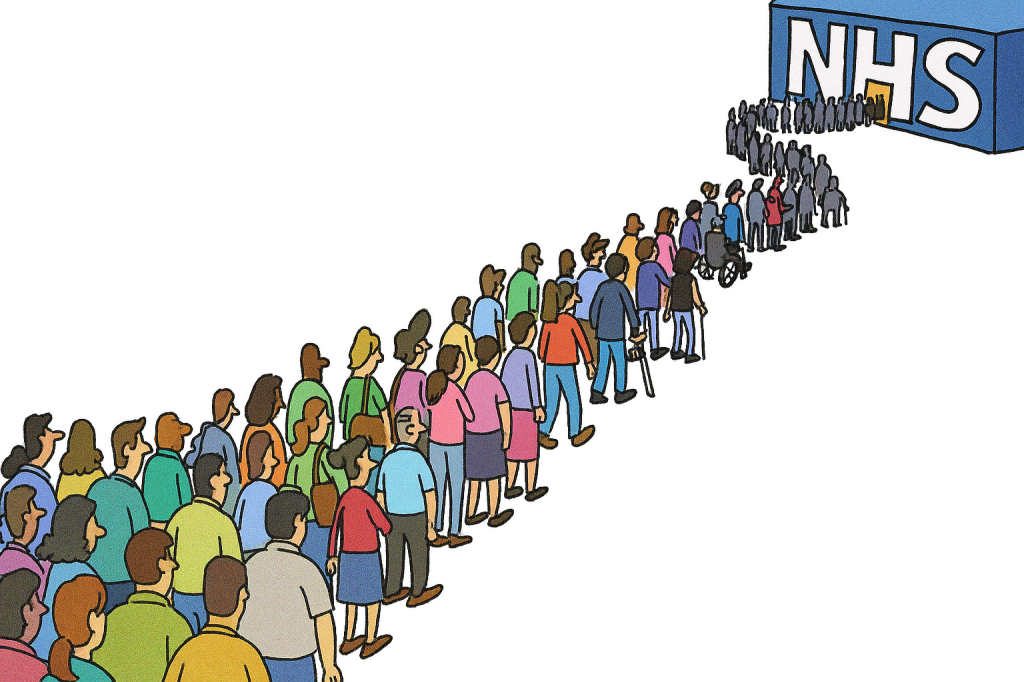
The Guardian has revealed (1 August 2025) what MMG has long suspected: that nearly 3 million patients on NHS England waiting lists have received no care at all since their GP referral – no diagnostic test, no specialist appointment. This “invisible crisis” affects almost half of all listed patients and casts serious doubt on government pledges to reduce waiting times. (The Guardian, “Three million on NHS England waiting lists have had no care since GP referral,”)
The Guardian’s revelation that nearly half of all patients currently on NHS England waiting lists have received no care whatsoever since their GP referral, caused understandable shock across the UK. The figures, based on unreleased NHS England data and analysis by MBI Health, show that 2.99 million of the 6.23 million people on hospital waiting lists – almost 48% – have not yet had their first specialist consultation or even a diagnostic test. For many, this was a revelation.
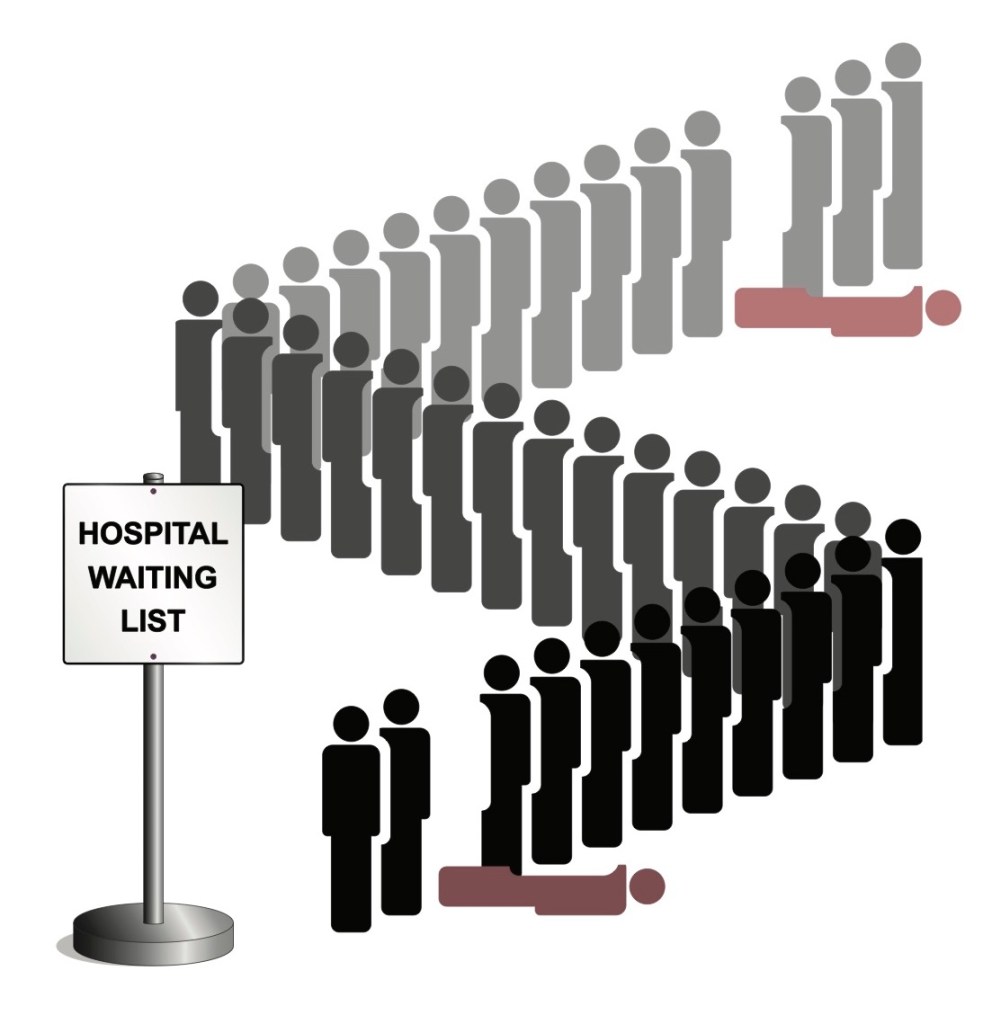
For those of us at My Medical Gateway (MMG), it was not. This is the very crisis we were built to confront.
We have spoken often about the limitations of the NHS’s reported figures – numbers which have, for years, painted an incomplete picture of the true backlog. Now, this new data confirms it: the system isn’t just congested; it’s failing at the front door. Millions of patients are not waiting for surgery, they’re waiting for a basic acknowledgement that they exist in the system at all.
Rachel Power of the Patients Association described the situation to The Guardian as “an invisible waiting list crisis.” That term could not be more apt. These are not abstract numbers. They are real people: young women awaiting gynaecological scans, elderly patients losing vision while they wait for ophthalmology referrals, children with gastrointestinal issues whose diagnostic tests are nowhere on the horizon. They are patients in pain, often undiagnosed, caught in a healthcare purgatory where no call comes and no plan is made.
The implications are profound. Of the 3 million people with no first contact, a third – one million – have already waited longer than the government’s supposed maximum limit of 18 weeks. Even the government’s central health pledge, to ensure 92% of patients are treated within that time frame by 2029, now looks increasingly unachievable. Not only are patients waiting months for treatment, but they are also waiting months just to begin their journey.
Thanks to MMG’s own internal research, none of this comes as a surprise. We have long held that the true number of people waiting for care – especially for conditions like sports injuries and workplace-related musculoskeletal issues among working-age adults – far exceeds what official figures suggest. Barry Mulholland, founder of MBI Health, captures the issue precisely: this is not a “backlog” but a “frontlog” – millions of patients who haven’t even had their first contact. Without addressing that initial access point, the NHS cannot realistically hope to reduce its elective care burden, no matter how many procedures are ultimately carried out.
What’s worse is that some of the most delayed areas – ENT, orthopaedics, ophthalmology, gastroenterology and gynaecology – are precisely the specialities where early intervention makes a long-term difference in outcomes. Delay here is not just a matter of inconvenience; it’s a matter of declining health and missed chances.
The government’s response, citing “record investment” and “fundamental reform,” does little to address the urgency of the crisis for those in limbo now. While it is true that progress has been made in delivering appointments – reportedly 4.6 million in the past year – this does not erase the reality of 3 million people who haven’t been seen once. That’s not healthcare. That’s system failure.
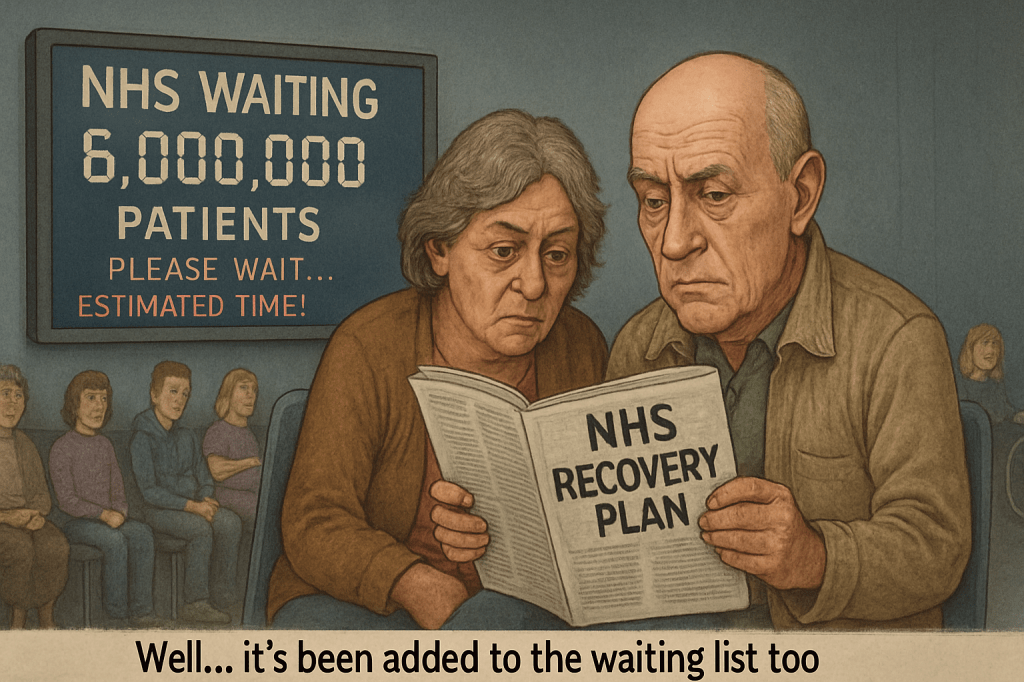
MMG is not waiting for 2029. We’re not asking patients to accept delay as normal. Our platform connects individuals directly with world-class accredited hospitals across Europe, where diagnostic appointments can happen in days and treatment pathways begin immediately. The goal is not to replace the NHS but to offer patients something the NHS cannot: timely and affordable access to care when it matters most.
This is not a luxury; it’s a necessity. As Liberal Democrat health spokesperson Alison Bennett rightly observed, “Behind every one of these numbers is a person in pain.” It is time the healthcare conversation in the UK recognised this not just as a problem of capacity, but of fairness and urgency.
The NHS remains a vital institution. But it is not enough to defend its ideals while millions are left unseen. It is not enough to promise better outcomes years into the future while people suffer today. If the NHS is overwhelmed, patients deserve options – and they deserve them now.
 My Medical Gateway Blog
Leave a comment