

Is the NHS really free if you can’t use it when you need it? In this blog, we unpack what “free at the point of use” really means — and why rationing in the NHS often means delays, not care. We compare the British model with healthcare systems in Europe and Australia, where patients get fast, free access via insurance cards. Discover how My Medical Gateway offers UK patients a practical alternative — fast.
The British NHS has long been celebrated for being “free at the point of use” — a phrase that evokes reassurance, fairness and accessibility. It suggests that no one in Britain pays a penny for healthcare when they need it, and that medical help is always there for those who need it most.
But is that the full story?
At My Medical Gateway (MMG), we work with patients every day who find themselves caught in the contradiction of this promise. What many discover — painfully — is that while NHS care may be free at the point of use, it is not always available at the point of demand.
Let’s take a deeper look at what “free” really means, and how other healthcare systems manage to offer the same benefit — often with greater speed and flexibility.
Rationing: The Hidden Price of NHS Access
The key feature of the NHS is its tax-funded, universal model, which means services are centrally budgeted and delivered based on need. But since budgets are finite and demand is growing, rationing becomes the only way to balance the books.
This rationing takes the form of:
- Waiting lists for surgeries and specialist consultations
- Eligibility thresholds for certain procedures
- Postcode lotteries in access to care
- Limited time with GPs and consultants
So while NHS care might be free at the door, patients increasingly find the door is locked, or at the very least, slow to open.
What Happens Elsewhere? European and Australian Models
Across much of Europe and Australia, healthcare systems operate very differently — but with strikingly similar outcomes: care is free at the point of use, and more importantly, it is available when you need it.
In countries like Germany, France, Austria, and Australia, the model is based on state or employer-backed insurance schemes. Every citizen holds a health insurance card, which they present at hospitals or clinics. Just like the NHS, there’s no money exchanged between patient and provider at the moment of care.
So what’s different?
In these systems:
- Hospitals and doctors operate with multiple payers (insurance companies or state insurers)
- The system funds more providers, including many private hospitals that deliver public care
- There are minimal or no wait times for diagnostics and operations
- Patients have freedom to choose their provider — public or private — without incurring out-of-pocket fees
In essence, your health insurance card works like an NHS card — but with more doors open to you.
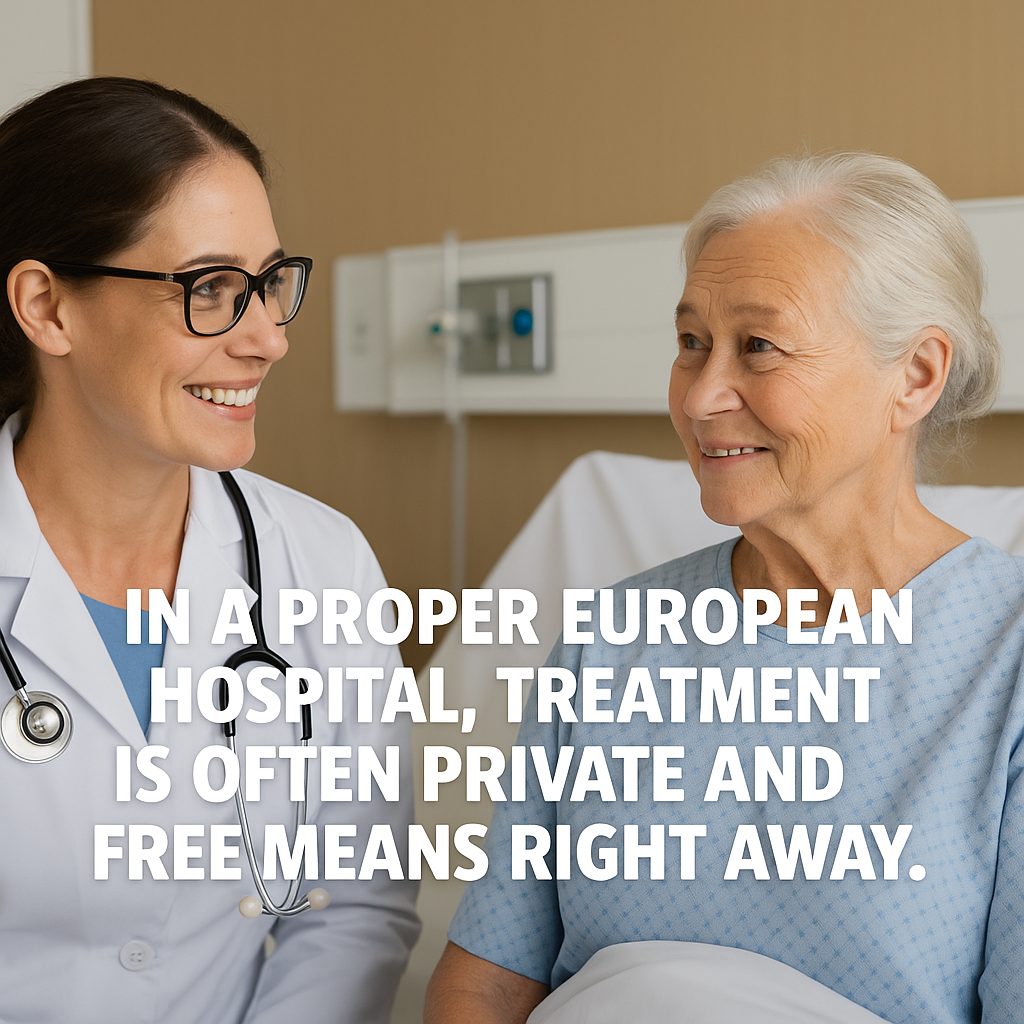
Let’s Be Clear: “Free” Is About Who Pays — Not How It Works
The confusion often arises from the idea that private care or insurance-based systems must involve patients paying out of pocket. But this is a myth.
If you live in Germany, for instance, you can visit a leading orthopaedic hospital, have a hip replacement done in under three weeks, and walk out without ever touching your wallet. The insurance company pays, not you — just like the NHS does in the UK.
The difference is speed, access and choice — not the cost at the door.
Similarly, in Australia, the public “Medicare” system covers care at both public and many private hospitals. Patients present their Medicare card, and the hospital bills the government directly. Again — no cash, no hassle, and no delays for those insured.
What This Means for British Patients
When British patients explore treatment options abroad — especially through My Medical Gateway’s partner hospitals in the EU — many are surprised to find just how similar the experience is to what they expected from the NHS.
✔ No cash exchanged at the hospital
✔ Treatment arranged through trusted, regulated providers
✔ Diagnostic reviews and surgery scheduling done rapidly
✔ Post-op care and reviews included
What’s different? The timeline. While the NHS might offer you surgery in 12 months, the MMG platform offers you three dates within six weeks of diagnosis.
Many MMG users pay for this care out of pocket, or through medical travel insurance, which mimics the same third-party pay model used in Europe — ensuring the patient is never exposed to surprise costs.
Why This Matters: Ending the Confusion
“Free at the point of use” is a powerful promise — but it’s also incomplete. The modern healthcare conversation must distinguish between cost and availability. The reality is:
- In the UK, your NHS card means you won’t be billed — but you may wait months or even years for surgery.
- In Europe or Australia, your insurance card also means you won’t be billed — but your care starts next week, not next year.
By opening up access to accredited EU hospitals, MMG empowers patients to experience what public healthcare should feel like: fast, affordable, and seamless.
Final Word
Free healthcare shouldn’t mean frustrating delays. Whether it’s the NHS or a European system, what matters most is that the care you need is there when you need it — and that it doesn’t break the bank.
At My Medical Gateway, we’re proud to offer UK patients a safe, modern alternative: one where free at the point of use also means ready when you are.
Find out more at www.MyMedicalGateway.com or call 0161 9600 700. Because your health shouldn’t wait.
 My Medical Gateway Blog
Leave a comment